Public Comment, Regarding Beaverton Downtown Association Censorship And Behavior
By David Anderson
Beaverton Downtown Assocation used generative AI in its marketing flyers and cartoon mascot imagery. Amidst widespread backlash of datacenters and AI “slop” that many view hand in hand, the public reacted as you might think.
Dozens of local community members — some artists, others business owners, and several political candidates — either called out BDA publicly on its use of generative AI, or commented in more general terms about the dangers and harm caused by using generative AI in a way that replaces traditional art talent.
The company hired to produce the work admitted to using AI tools within Photoshop to color “Beverly the Beaver”, but Meta’s own platform identified at least one of BDA’s posts using Beverly as “entirely AI-generated”:
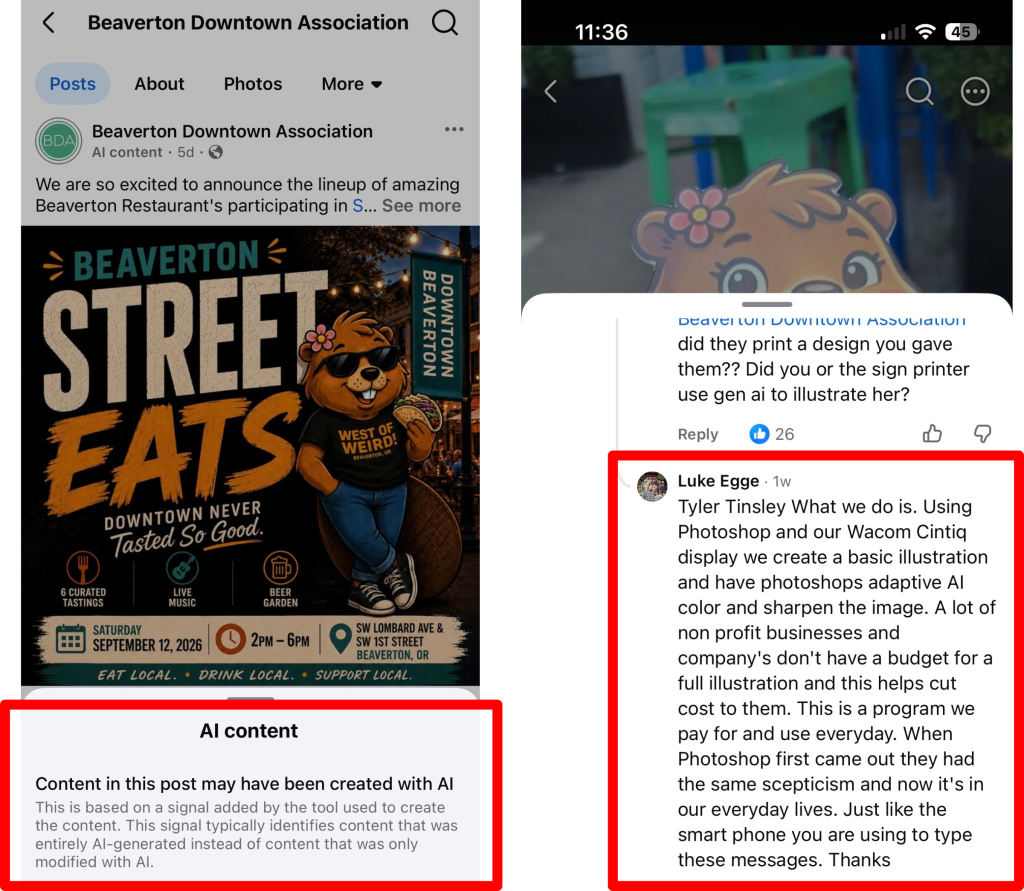
A user commented on a post by BDA on Facebook they were blocked after stating that the text detailing of Beverly was clearly AI generated. We found one such image and it contains the tell-tale artifacts that suggest the entire image of Beverly, not just the “fill-in coloring”, was produced using generative AI:
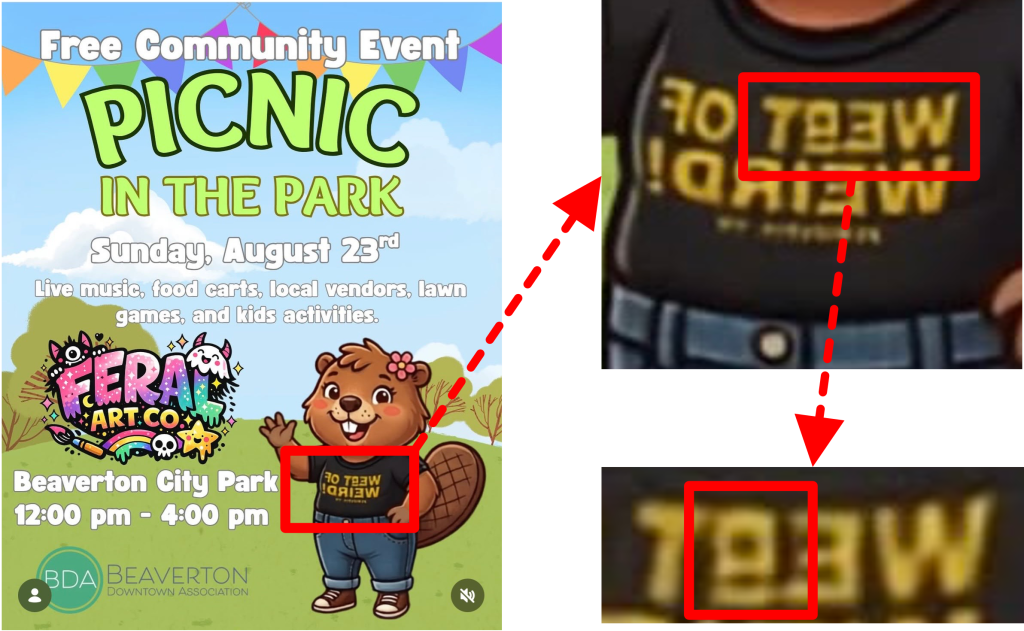
Specifically, the backwards lettering on Beverly’s “shirt” includes blurred text with artifacts showing AI treated the lettering as pixels, rather than text. Artifacts like this are created when a generative AI tool is instructed to create imagery, without precise rules to prevent such “slop”.
It is similar to artifacts in AI-modified photographs that show elected officials with an incorrect number of fingers on one hand, as just a simple example.
Many of the concerned social media users subsequently found themselves blocked from accessing BDA’s social media accounts, including Instagram and Facebook. In every case, the user was given no warning or notice that their behavior went against any sort of community standards enforced by BDA.
One such example includes Kenton Antiques, who publicly shared their own experience being blocked after writing a message aimed at supporting artists, and in no way targeted the BDA:
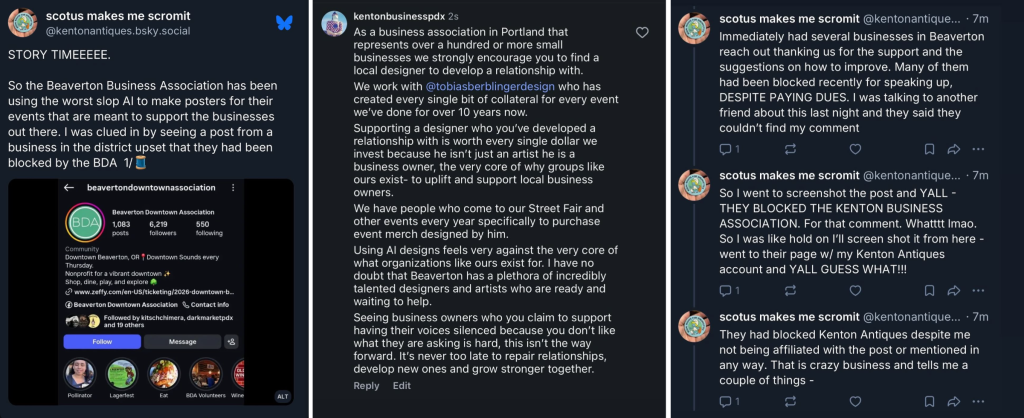
Shortly after, a number of small businesses, including Mutts Coffee, as well as our own business, Syndicate Wine Bar, published statements informing the public of their respective positions against the use of generative AI. Those social media posts were then flooded with community comment from users, all stating they had been blocked by BDA for simply asking BDA why it is using generative AI.
Then, the press got involved. A reporter from the Beaverton Valley Times reached out and asked several questions. Saturday afternoon (September 12, 2026), the Beaverton Valley Times published their article:
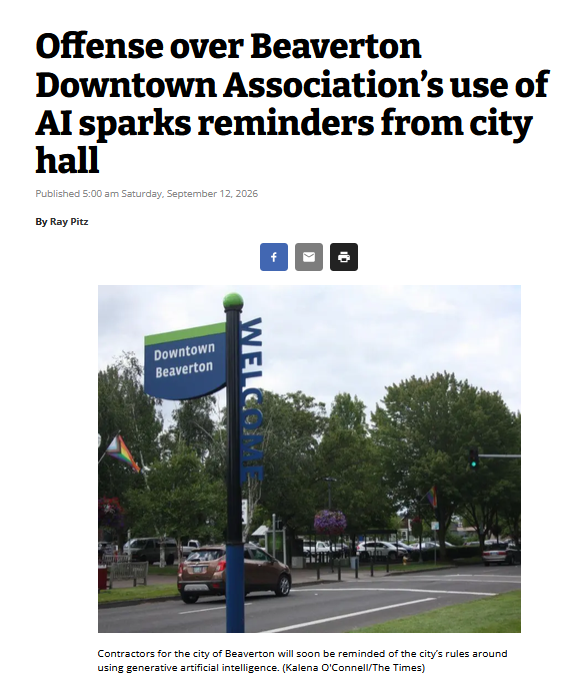
Offense over Beaverton Downtown Association’s use of AI sparks reminders from city hall
https://beavertonvalleytimes.com/2026/09/12/offense-over-beaverton-downtown-associations-use-of-ai-sparks-reminders-from-city-hall/
Response from City of Beaverton
The article notes that Mayor Lacey Beaty will direct the City to review how it works with contractors that use AI. The article doesn’t mention that City Council just renewed BDA’s contract for another year, so that funding is locked in, unless City Council retroactively votes to alter the terms of BDA’s funding.
The article further notes that the City’s current policy doesn’t forbid the use of AI, just that AI-generated works must indicate they were created using the technology, so it’s unclear what the Mayor intends to accomplish by “reminding contractors of its policy.”
Also in the article, BDA Chair Kirsten Agard is quoted indicating Beverly the Beaver was modified with “Al-assisted Adobe tools used only for ‘sharpening and colorization.'” The example of Beverly above suggests generative AI was used far more extensively than to just “color” and “sharpen” the illustration.
Reaction From Small Businesses
Jaclyn Leedy, owner of Mutts Coffee, indicated they had been blocked from several BDA social accounts. Leedy further said, “I predict between 20-30 other accounts have also been blocked and some of them are longtime Beaverton residents, business owners and other key stakeholders.”
Leedy’s quote can be corroborated simply by viewing the comments on Mutts’ own social media posts; By browsing public comments on BDA’s various social media posts on both Facebook and Instagram; And by browsing the /beaverton subreddit regarding the incident, in which numerous additional users all state they were blocked without explanation:
https://www.reddit.com/r/beaverton/s/OSkuULZ1If
Response from BDA
Nevertheless, Agard says none of this is true:
Agard states in the article, “The decision followed an ongoing pattern of interactions that we determined had moved beyond constructive criticism and were inconsistent with the BDA’s Community Interaction Standards,” and, “The decision was based on conduct, not viewpoint.”
So, there you have it. The entirety of the Beaverton community that found itself blocked, was blocked for violating BDA’s Community Interaction Standards.
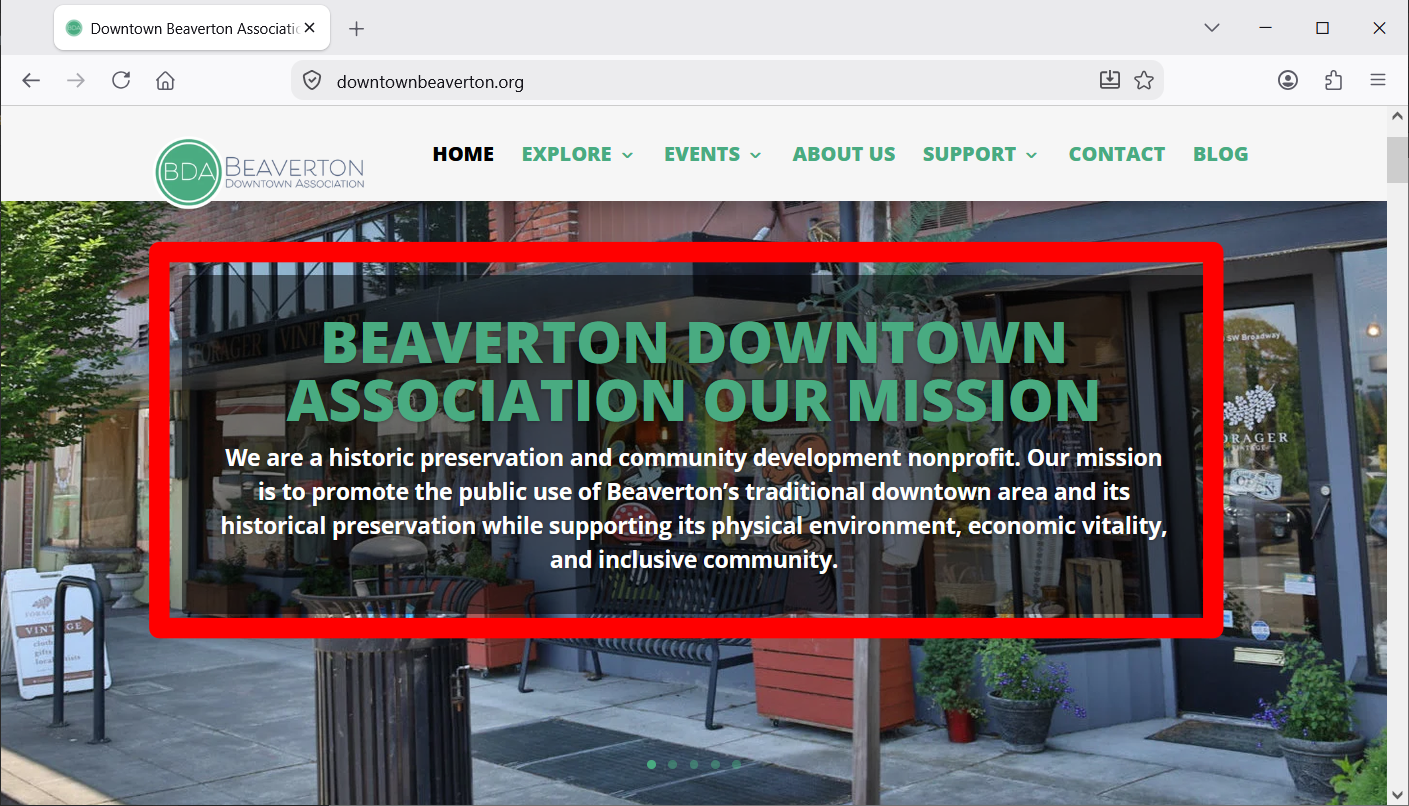
What does BDA’s Community Standards document contain? Here’s a copy. It’s posted as a rather large button at the top of the About page of BDA’s website:
The document highlights various infractions or types of “bullying” that may constitute a violation and breach their zero-tolerance policy. However, it also states, as part of its DEI policy that it aims for:
“Treating all community members and businesses with respect and dignity. This means that all residents, employees, volunteers, and clients of our partner organizations will be treated with respect and dignity, regardless of their personal characteristics.”
The author of this post is having a difficult time understanding the gap between what BDA’s Community Standards document is supposed to provide as a framework, versus how the BDA has in reality behaved towards members of the very community it is supposed to serve.
Let’s Talk About Conduct
Since Ms. Agard opened the door on this topic, let’s discuss the word, “conduct.”
Agard’s comments suggest that conduct by artists and community members concerned about a community association’s use of generative AI, somehow violates BDA’s Community Interaction Standards. This is why those artists and community members were blocked.
Agard’s comments suggest that conduct by business owners alarmed that a community association could behave so anti-community, somehow violates BDA’s Community Interaction Standards. This is why those business owners were blocked.
Agard’s comments suggest that conduct by political candidates advocating for their constituents because a community assocation would not, somehow violates BDA’s Community Interaction Standards. This is why those political candidates were blocked.
So, what about conduct by a family member of Ms. Agard harassing and taunting some of these blocked individuals?
A certain “O. Agard” (we will not publish their full name) posted the following comments on a thread by Mutts Coffee, launching into commenters, including my wife, Angela Anderson who said nothing about the BDA anywhere online:
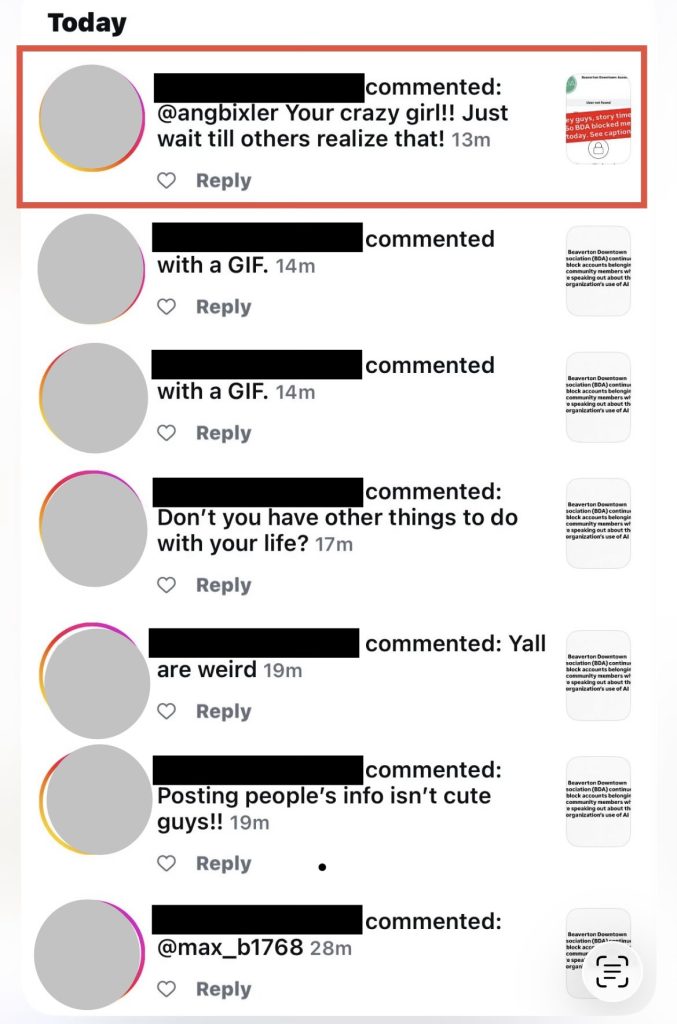
In reality, what Angela DID do, was privately email the BDA recently on two separate occasions, several weeks ago, regarding disruption to local businesses caused by BDA events in the First Street Dining Commons. Business owners had come to Angela literally begging for her assistance, so she spoke up about their concerns. This is called “advocacy”, not “bullying”.
Angela did not post anything publicly. Rather, she communicated her concerns with BDA directly, privately, and professionally. These emails are available for public reading, if anyone wants to see them. Angela’s intentions were to find a solution for our business neighbors, at a time when BDA events seemed to show disregard for community members that work every single day in the district to build it into something more.
Nevertheless, Angela found her own personal account blocked from accessing BDA’s Facebook and Instagram accounts.
And then, O. Agard published a statement suggesting Angela is “crazy”, with an undertone threat reading, “wait till others realize that.” The Agard family would be wise to understand the very real civil liabilities for defamation of character stemming from libel.
The mistreatment and harassment of Angela and others, publicly, is powerful evidence of the unprofessional manner in which BDA operates under the leadership of Kirsten Agard. Their own comments in the Beaverton Valley Times are on display for all to read. The dozens of community members that have been blocked know in their own hearts and minds that they did nothing to warrant the action.
Summary
A downtown association exists to serve constituents of its district boundary. Two years ago, BDA expanded its boundary northward to include Central Beaverton, as well as the original footprint of Old Town.
As a downtown association, BDA receives funding from the City, as well as grants from Main Street America, a national organization tasked with ensuring downtown associations operate within compliance of their charter.
In blocking dozens of community members, BDA has demonstrated it doesn’t believe it exists to serve certain members of the community. While the full extent isn’t yet known, dozens of community members are no longer served by BDA’s own actions to block and effectively silence them.
When an organization closes its eyes and ears to a portion of its audience without justifiable cause, it demonstrates censorship. Without recourse or correction, that organization will have no reason to alter its behavior or policies, correct violations of its own standards, or demonstrate goodwill towards the community it is tasked with serving.
Why should anyone, any business, any artist, or any political candidate in Old Town or Central Beaverton want to interact with Beaverton Downtown Association if in expressing their own views, find themselves in violation of contradictory Community Standards guidelines? Why should anyone want to risk saying or writing the “wrong thing”, that might be met with disdain from BDA leadership, or worse, the entire organization and its dozens of volunteers?
Who wants to run the risk of having their personal character attacked or judged as inappropriate by an organization that itself demonstrates such unprofessional behavior?
What do we, as a community of constituents, want in a downtown assocation? Until BDA’s leadership is corrected and the organization’s entire structure rebuilt — including its Community Standards statement — we will have no confidence in the BDA or its leadership.
At this time, we call for a vote of no confidence in Kirsten Agard, Chair of Beaverton Downtown Association.
